




News&Topics
The 32nd Cross Cultural Event was held.
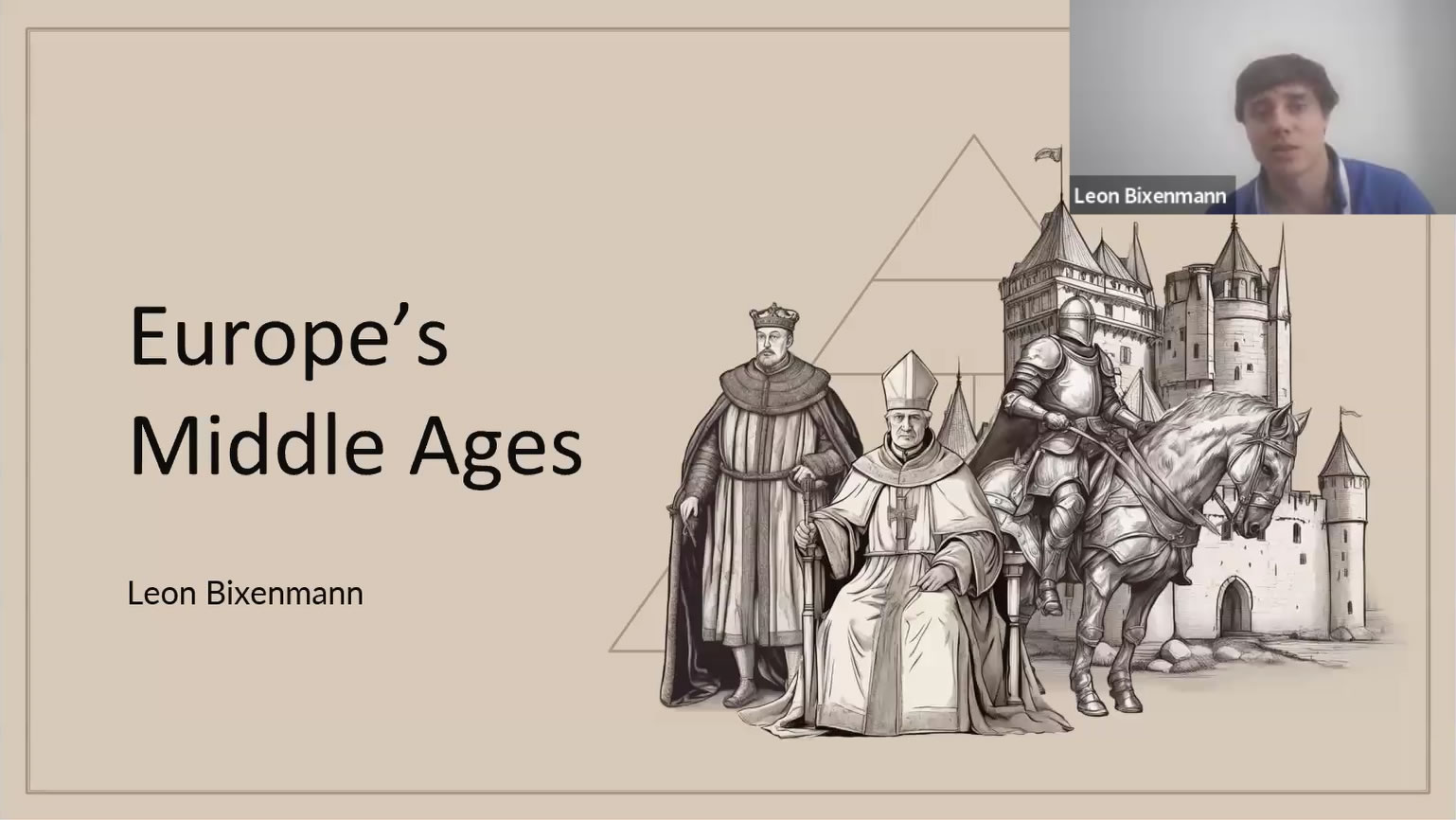
On November 20, iCONM held a Cross-Cultural Event for its staff members, facility users, and representatives from Kawasaki City and the Kawasaki Institute of Industrial Promotion. In this session, Dr. Leon Bixenmann from the Kataoka & Kinoh Lab at iCONM introduced the history of his home country, Germany, focusing on medieval Europe.
The session began with an overview of the formation of medieval Europe. The Middle Ages refer to the period roughly between 500 and 1500 AD. Before this era, the famous Roman Empire existed, spanning not only Europe but also parts of Asia and Africa. The empire was known for its advanced infrastructure, including aqueducts, public baths, and theaters, which allowed for a remarkably high standard of living at the time. However, the vastness of the empire meant that diverse peoples and religions coexisted, eventually leading to conflicts. As a result, the empire fragmented and ultimately fell. Following the collapse of the Roman Empire, numerous small kingdoms and territories emerged in the once-unified lands, marking the beginning of medieval Europe. Conflicts continued, and Europe gradually divided into regions such as West Francia (modern-day France), East Francia (modern-day Germany), and Italy, forming the foundation of the Europe we know today.
Leon also introduced various aspects of medieval life, including town layouts centered around churches and castles, weapons such as crossbows and cannons that could easily pierce knightly armor, and the Black Death, a deadly epidemic caused by the plague bacterium. Participants commented, “It was great to learn more about medieval Europe, which is also popular in Japan.” While German culture has been introduced in previous sessions, this was the first time the focus was on history. It was a valuable opportunity to gain new insights by exploring the same country from a different perspective.