




News&Topics
The 37th Cross Cultural Event was held.
On July 27, iCONM held a Cross-Cultural Event for its staff members, facility users, and representatives from Kawasaki City and the Kawasaki Institute of Industrial Promotion. In this session, Prof. Huang Yugang of the School of Pharmaceutical Sciences at Guangzhou Medical University, currently a visiting researcher in the Kataoka & Kinoh Lab at iCONM, introduced Guangzhou, China, where he lives and works.
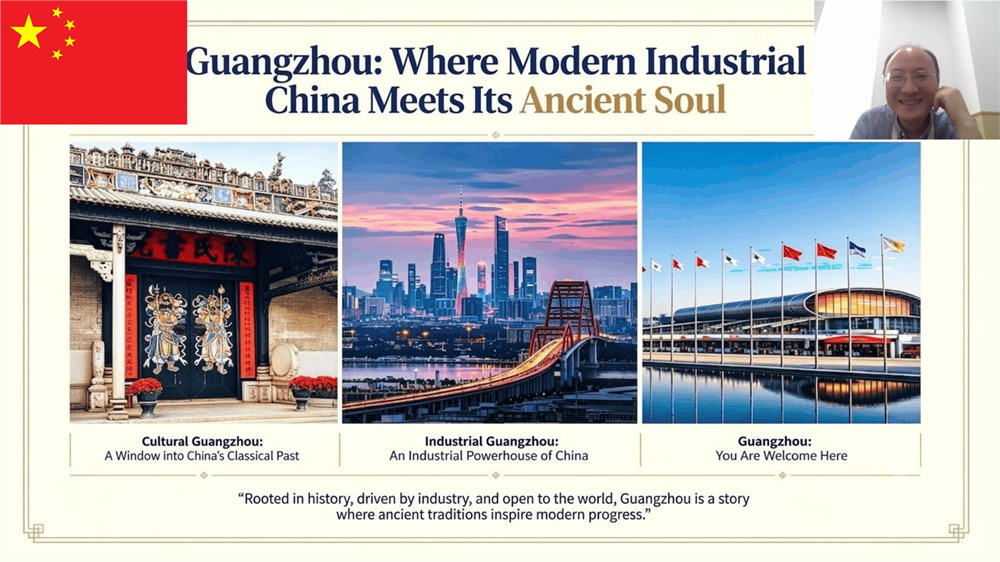
The presentation first introduced Guangzhou’s location and history. Located in southern China, Guangzhou is one of the major cities in the Guangdong-Hong Kong-Macao Greater Bay Area, together with Hong Kong and Macao. The city has a long history, and one of its symbols is the Five Rams Statue, which is associated with a legend in which five immortals came to Guangzhou riding five rams and brought rice stalks to the people. The Pearl River, which flows through the city, is also known for its beautiful night views, and Huang recommended taking a night cruise on the river when visiting Guangzhou.
While Guangzhou has a long history, it is also one of China’s leading industrial cities. Manufacturing industries such as automobiles, new energy vehicles, electronics, industrial robots, and batteries are thriving, while further growth is expected in fields such as biopharmaceuticals and AI. Guangzhou is also home to the China Import and Export Fair, commonly known as the Canton Fair, which has been held since 1957 and attracts visitors from around the world. A video showing the actual venue gave participants a sense of the event’s impressive scale and lively atmosphere, with its numerous booths and vast range of products.
Next, Huang introduced Lingnan culture, which is deeply rooted in Guangzhou. As a city located close to the sea, Guangzhou has long developed an open culture that embraces influences from outside the region. Participants learned about traditional architecture, including the Chen Clan Ancestral Hall, known for its elaborate wood carvings, ceramics, and sculptures, as well as distinctive local arts and culture such as the Lingnan School of Painting and Cantonese Opera.
Dragon boat racing, held around the time of the Dragon Boat Festival, was also introduced as one of Guangzhou’s representative traditional events. In a video shown during the presentation, long boats decorated with dragon heads raced across the water at an astonishing speed, powered by large teams of paddlers. The boats were moving so fast that one participant even asked whether the video had been sped up. The powerful and dynamic race left a strong impression on the participants.
Food culture is another essential part of Guangzhou. Huang introduced a variety of Cantonese dishes, as well as the local tradition of morning tea, or yum cha, in which people enjoy dim sum together. Food also became a lively topic during the Q&A session, with one participant who had previously visited Guangzhou strongly recommending Cantonese cuisine. When another participant mentioned a restaurant near Kawasaki Station where people can enjoy authentic Guangzhou-style cuisine, the conversation even led to the suggestion, “Let’s all go together next time.”
Through this event, participants also recognized a common feature shared by Guangzhou and Kawasaki: both cities have developed as major industrial centers. Although the two cities are located in different countries and have different cultures, looking at how they have developed reveals some interesting similarities. With these similarities in mind, the event provided an opportunity to deepen participants’ understanding of Guangzhou’s history, culture, and its present-day character.